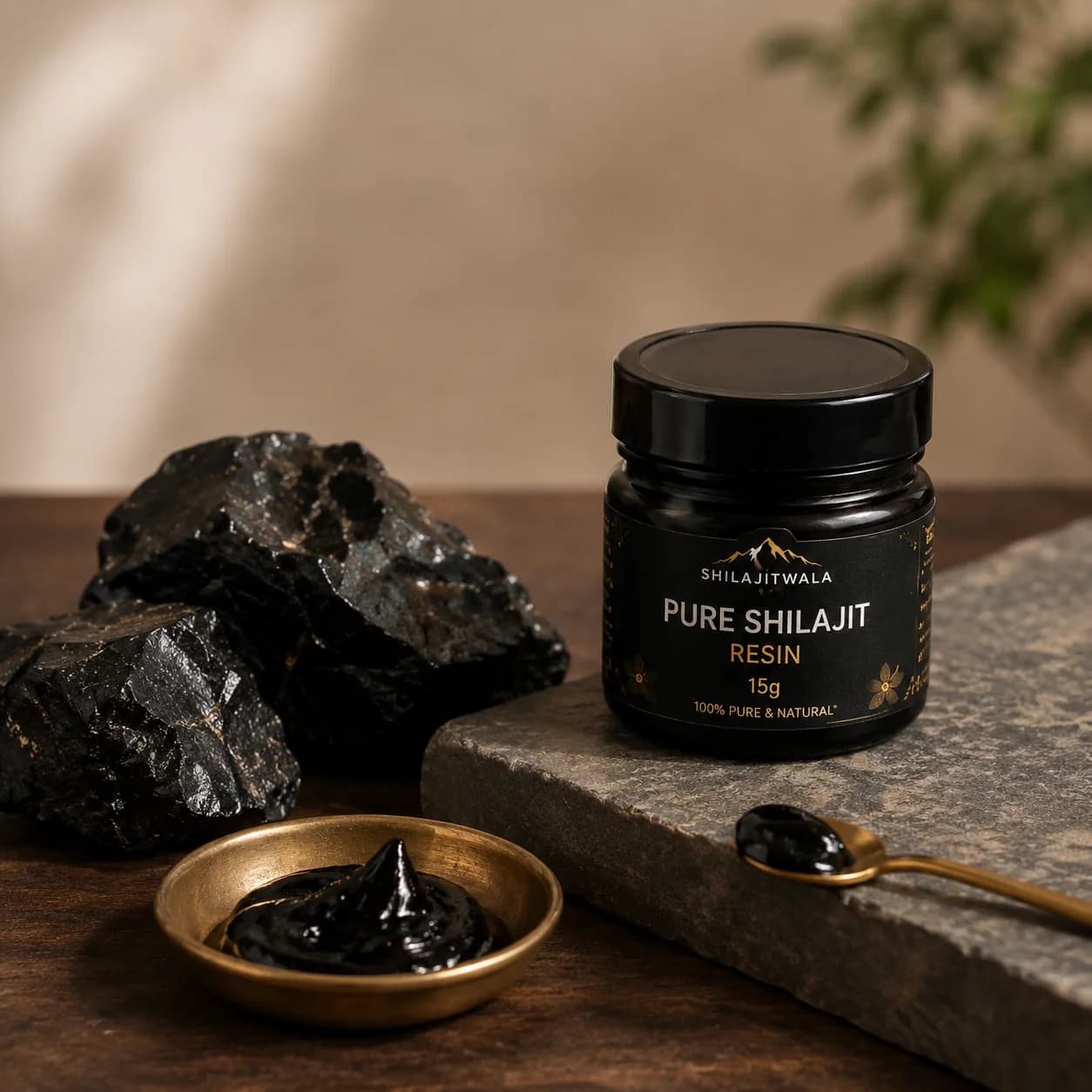
Shilajit as a natural material
Shilajit is commonly described as a dark, mineral-rich exudate or natural material collected from mountain rock environments. Its composition can vary by source, processing and product specification.
Scientific descriptions of humic substances and minerals do not mean every jar has the same composition or effect.
Commercial formats are not interchangeable
Resin is semi-solid and usually measured manually. Powder is dry and easier to measure by weight, while capsules provide fixed units but may include additional ingredients.
Compare the ingredient amount, full ingredient list, serving instructions and storage requirements for the exact format.
What a useful label should include
A buyer should be able to identify the product without relying on the front-label slogan.
- Product name and format
- Net weight or quantity
- Complete ingredient declaration
- Serving and preparation directions
- Warnings and storage
- Responsible business
- Lot code and date information
What Shilajit is not proven to do
The presence of minerals or traditional use does not prove that a product will treat disease, guarantee fertility, raise testosterone or work the same way for every person.
Health claims should be separated from product identity and quality questions.
Shilajit and Salajeet are common names for the same product category
In Pakistan, searches often use Shilajit, Salajeet or Salajit for the same broad natural material. Spelling differences do not tell you whether two commercial products have the same composition, processing or concentration.
When comparing products, move past the name and read the ingredient declaration, format, net amount and preparation information. A resin jar, capsule blend and powder can all use the word Shilajit while still being materially different purchases.
The word fulvic acid does not tell the whole quality story
Shilajit is commonly discussed in relation to humic substances and fulvic-acid fractions, but a single percentage or marketing claim does not establish complete identity, purity or safety.
Quality assessment should also consider traceability and contaminants. Peer-reviewed work has highlighted the importance of elemental and heavy-metal evaluation because natural mineral-containing materials can vary by source and processing.
Common questions
Frequently asked questions
Is Shilajit a mineral?
It is a complex natural material that can contain mineral and organic components. The exact composition varies and should not be reduced to one simple category.
Is Shilajit resin always pure?
No. Resin describes physical format. Purity requires appropriate product controls and evidence.
What should I check first?
Start with the ingredient declaration, format, net amount, lot code, dates, responsible business and use instructions.
Are Salajeet and Shilajit different?
They are commonly used as alternative spellings or names for the same broad product category in Pakistan. Always compare the exact product label rather than the spelling.
Does a fulvic-acid percentage prove quality?
No single percentage proves complete identity, purity or safety. Ask how it was measured and review the rest of the product information and relevant testing.
Evidence and regulation
Sources used for this guide
These sources provide regulatory, safety and quality context. They do not certify a specific product unless the source explicitly identifies it.
- Botanical Dietary Supplements: Background InformationNIH Office of Dietary SupplementsOfficial background on botanical identity, standardisation, evidence and quality differences.
- Heavy Metals and Humic Substances in ShilajitPubMedPeer-reviewed review focused on heavy-metal toxicity and quality control.
- Determination of Nutritional and Poisonous Metals in ShilajitPubMedAnalytical study supporting elemental testing in Shilajit quality evaluation.
- Alternative Medicines and Health Products — Product CategoriesDrug Regulatory Authority of PakistanOfficial description of herbal and health-product categories in Pakistan.