Why common home tests are limited
Shilajit can soften with warmth, firm in cooler conditions and dissolve differently depending on processing and moisture. Other substances can imitate these behaviours.
Burning, stretching, freezing or mixing a sample in water cannot identify heavy metals, microorganisms, undeclared ingredients or every form of adulteration.
- Water-solubility test
- Flame or smoke test
- Freezer test
- Stretch or thread test
- Colour and smell alone
Check the label and seller first
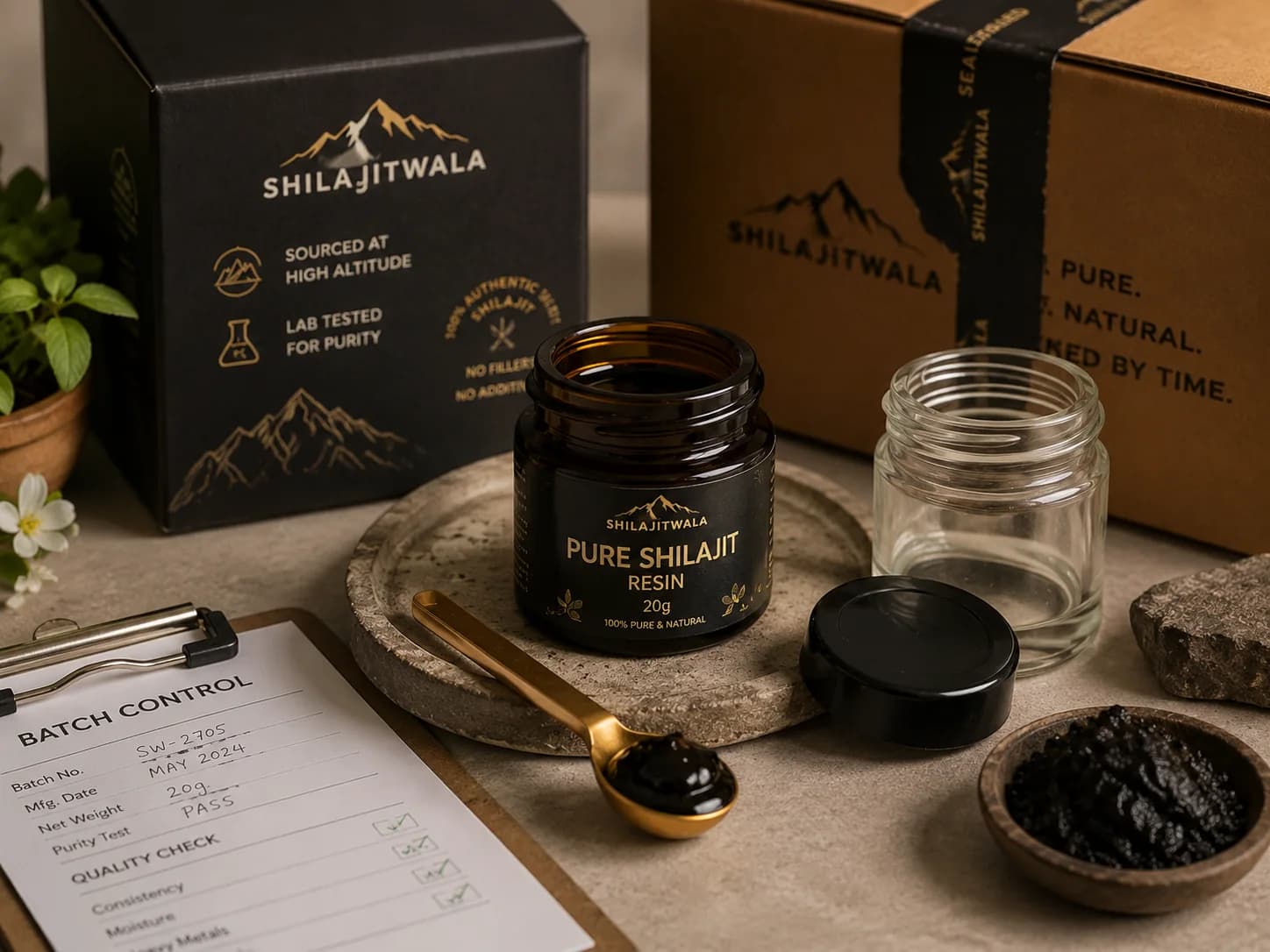
The product should have a clear name, format, ingredient declaration, net weight, directions, warnings, lot code, dates and responsible business information.
The seller should be able to explain who packed or supplied the product and how the exact jar can be connected to any quality document provided.
- Readable lot code and dates
- Consistent product code or SKU
- Complete ingredient line
- Seller contact details
- Storage and warning information
Read laboratory documents carefully
A report is useful only when it identifies the tested sample and states what was measured. Look for the laboratory, date, methods or analytes, units, results and reference limits.
Do not assume that a generic certificate, an old report or a document for another product proves the quality of the jar in your hand.
Know when to stop using the product
Do not use a product with a broken seal, unreadable dates, unexplained contamination, inconsistent labelling or an unusual change that concerns you. Keep the pack and contact the seller.
If you experience a concerning reaction, stop use and seek appropriate medical advice rather than trying a larger amount or another home test.
Separate authenticity, purity and safety
These three questions are related but they are not the same. Authenticity asks whether the material is what the seller says it is. Purity asks whether undeclared substances or excessive contaminants are present. Safety also depends on the amount used, personal health circumstances, medicines, storage and product handling.
A jar can look and behave like Shilajit and still fail a contaminant test. Likewise, a laboratory document may report selected metals without proving botanical or geographic origin. Treat each type of evidence only as evidence for the question it actually answers.
Photographs can help, but they cannot certify a sample
Clear photographs are useful for checking the seal, label, lot code, date information and visible changes in the jar. They can also help a seller investigate whether the delivered pack matches its records.
A photograph cannot measure lead, arsenic, cadmium, mercury, microorganisms or undeclared ingredients. If a seller claims that a picture, colour or stretching test proves complete purity, the claim is stronger than the evidence.
- Photograph the front and back label
- Photograph the lot code and dates
- Keep the outer packaging and order reference
- Ask which report belongs to that exact lot
- Do not rely on appearance as a contaminant screen
Common questions
Frequently asked questions
Does original Shilajit dissolve in water?
Solubility can vary with processing and product composition. Dissolving in water does not prove full authenticity or contaminant safety.
Is very dark Shilajit always genuine?
No. Colour can vary and can be imitated. It should never be the only authenticity check.
What is the strongest practical check?
Confirm the exact label and lot code, then assess whether any supporting document clearly identifies the same product or sample.
Can an online video prove Shilajit is original?
No. A video can demonstrate appearance or behaviour, but it cannot establish the identity and safety of the jar you received.
What should I do if the certificate has no batch number?
Ask the seller how the document is connected to your product. If that connection cannot be explained, treat the certificate as general information rather than proof for your jar.
Evidence and regulation
Sources used for this guide
These sources provide regulatory, safety and quality context. They do not certify a specific product unless the source explicitly identifies it.
- Dietary Supplements: What You Need to KnowNIH Office of Dietary SupplementsConsumer guidance on supplement evidence, quality, interactions and safety.
- Botanical Dietary Supplements: Background InformationNIH Office of Dietary SupplementsOfficial background on botanical identity, standardisation, evidence and quality differences.
- Heavy Metals and Humic Substances in ShilajitPubMedPeer-reviewed review focused on heavy-metal toxicity and quality control.
- Determination of Nutritional and Poisonous Metals in ShilajitPubMedAnalytical study supporting elemental testing in Shilajit quality evaluation.
- Alternative Medicines and Health Products — Product CategoriesDrug Regulatory Authority of PakistanOfficial description of herbal and health-product categories in Pakistan.